South Korea is Google's #2 Market for Revenue Worldwide? (Surpassing Japan)
South Korea is Google's #2 Market for Revenue Worldwide? (Surpassing Japan)
"The End of GPT? The Shocking Report Card from Google Gemini 3 Flash"
I'm back after about 5 weeks. Thank you for waiting. I wasn't just resting during my break. The AI market landscape has been changing dramatically, so I've been digging into data all night.
Last month, Google released its entry-level model, 'Gemini 3 Flash'. I thought it was just a budget-friendly model, but after digging in, it turned out to be a monster on par with GPT-5.2. What's even more shocking is the reaction from the Korean market. Just one month after its release, the number of Korean users has exploded, and the gap with GPT is closing at a terrifying pace. Even the reason why 'AI' became the number one keyword in New Year's addresses from major corporations—Google is at the center of all these changes. The reason why OpenAI had no choice but to declare a 'Code Red,' and what we need to prepare for in the midst of this massive shift. In my comeback video, I'll reveal all that data in stark detail.
📝 Timeline 0:00 Back After 5 Weeks & Proof of Life 1:25 Gemini 3 Flash: A Monster in Disguise (Performance Analysis) 3:40 Korean Market Data Reveal: Proof That GPT is Losing Ground 5:15 Analysis of Corporate New Year's Addresses: Why Samsung Chose Google 6:50 Shocking Revenue Ranking: Where Are Koreans Spending Their Money? 7:20 Conclusion: OpenAI's Crisis and Google's Winning Scenario
📢 AI Models/Companies Mentioned Google Gemini 3 Flash, Gemini 3 Pro OpenAI GPT-5.2, GPT-4o Anthropic Claude, xAI Grok Samsung, SK (New Year's Addresses)
#GoogleGemini #Gemini3Flash #AITrends #OpenAI #GPT5 #Google #AIMarketAnalysis #CallitAI #ArtificialIntelligence #TechReview
Everyone, what did I tell you when Gemini 3.0 was released? I said that in the end, Google would come out on top, that Google is a god, and that the final winner of the AI war has already been decided.
When Google released its budget-friendly model, Gemini 3 Flash, on December 17th last month, many of you probably thought, "Oh, just another cost-effective model," and moved on.
But now, exactly one month after its release, do you know how the market landscape has changed? Today, I'm going to reveal in stark detail the chilling data report card that shows how Google is devouring the generative AI market in Korea, and why GPT, which once held the absolute throne, is losing its power.
Hello, this is CallitAI, your guide to surviving the AI era. I'm back with a new video after about five weeks. A lot has happened during that time. I went through some personal difficulties, but I've recovered a lot and I'm getting back into form.
I will keep pushing forward. Thank you for waiting. To the members who trusted and waited for me, and to everyone on Discord, thank you so much. Thanks to you, I was able to get back on my feet quickly. I'll soon show you 100% of what you've seen before, no, even more than that, so please wait just a little longer!
Now, let's get to the main point.
First, the arrival of a monster disguised as Flash, and the crisis for GPT
First, let's take another look at Gemini 3 Flash, which was released last month. Its name might be Flash, but its performance is anything but light. In fact, it's frighteningly powerful.
Right after its release, this model showed performance on par with its competitor's top-tier model, GPT-5.2, in benchmarks. It scored 33.7% on the 'Humanity's Last Exam' professional test. Considering the previous version was at 11%, that's an insane growth of over 3x.
In particular, its multimodal capabilities—the ability to understand video or analyze audio—scored 81.2%, making it the undisputed number one among all existing models.
Google has implemented this monster-performance model as the default model in the Gemini app. This means anyone in the world can now carry the intelligence of a top-tier GPT model in their pocket, for free.
On the other hand, OpenAI's situation is not looking good. While the release of the GPT-5 series did generate some "That's GPT for you" reactions, the appeal of its paid subscription model is rapidly declining as Google starts to release high-performance models for free. In fact, recent data suggests that the cancellation rate for GPT Plus is noticeably increasing. People are starting to think, "Do I really need to pay for GPT when Google provides it all for free?"
Moreover, Anthropic's Claude and Elon Musk's Grok are also rising fiercely. Claude is winning over developers with reviews claiming it surpasses GPT in coding and writing, while Grok is threatening the news search market with its weapon of real-time data from X (formerly Twitter). GPT is now caught in a sandwich between the giant that is Google and emerging powerhouses like Claude and Grok.
Google calls this Gemini 3 Flash model a Workhorse. With its insane cost-efficiency of $0.5 per million tokens, it has made companies choose Google without hesitation when processing large amounts of data.
Second, how Korean market data proves Google's counterattack
Now, for the really important part. After the Gemini 3 series was released, how did the Korean market, known for being the most sensitive to new technology, react? I'll prove it to you with numbers.
According to the latest analysis from Sensor Tower, the landscape of the Korean market is being completely overturned.
As of last October, in the generative AI advertising market, GPT held 53.9% while Google had a mere 5%. It wasn't even a competition.
But in December, after the release of Gemini 3, GPT's share plummeted to 33.9%, while Google's surged to 27.2%. This means that as soon as Google became confident in its product, it began a massive marketing carpet-bombing campaign in the Korean market with its vast capital.
The app usage is even more surprising. Since the launch of Gemini 3, the Daily Active Users (DAU) in Korea have exploded by a staggering 103.7%. This is the highest growth rate among major countries worldwide.
The gap with GPT is also closing rapidly. A year ago, the user count difference was over 7-fold, but now it has narrowed to about 4-fold. This is proof that Google's pursuit speed is far outpacing GPT's growth rate.
Third, the future as told by the New Year's addresses of major Korean corporations
This change isn't just limited to general users. If you look at the moves of the large corporations that drive the Korean economy, Google's victory becomes even clearer.
Do you know what the most mentioned word was in the New Year's addresses of Korea's top 10 conglomerates this year? It was AI. A keyword that was barely in the top 10 last year was mentioned a total of 44 times this year, instantly jumping to first place.
In particular, technology-leading companies like SK and Samsung have positioned AI as a prerequisite for survival. SK emphasized that they "must create new business models by combining AI knowledge," and Samsung Electronics declared they will "leap forward to become a leading AI company through AX innovation and overwhelming product competitiveness."
What does this mean? It means companies are moving beyond simply adopting AI and are starting to make it the core of their business. And when companies adopt AI, the most important factors they consider are stability, scalability, and cost-effectiveness.
Google's Gemini 3 Flash hits all three of these notes. GPT is expensive and heavy. Claude and Grok still lack a mature ecosystem. But Google has all the infrastructure, from Cloud, Search, and Android to workplace tools (Workspace). From a corporate perspective, there's no reason not to choose Google.
Fourth, Koreans spend money. On Google.
What's more shocking is the revenue. Korean users aren't just using it for free.
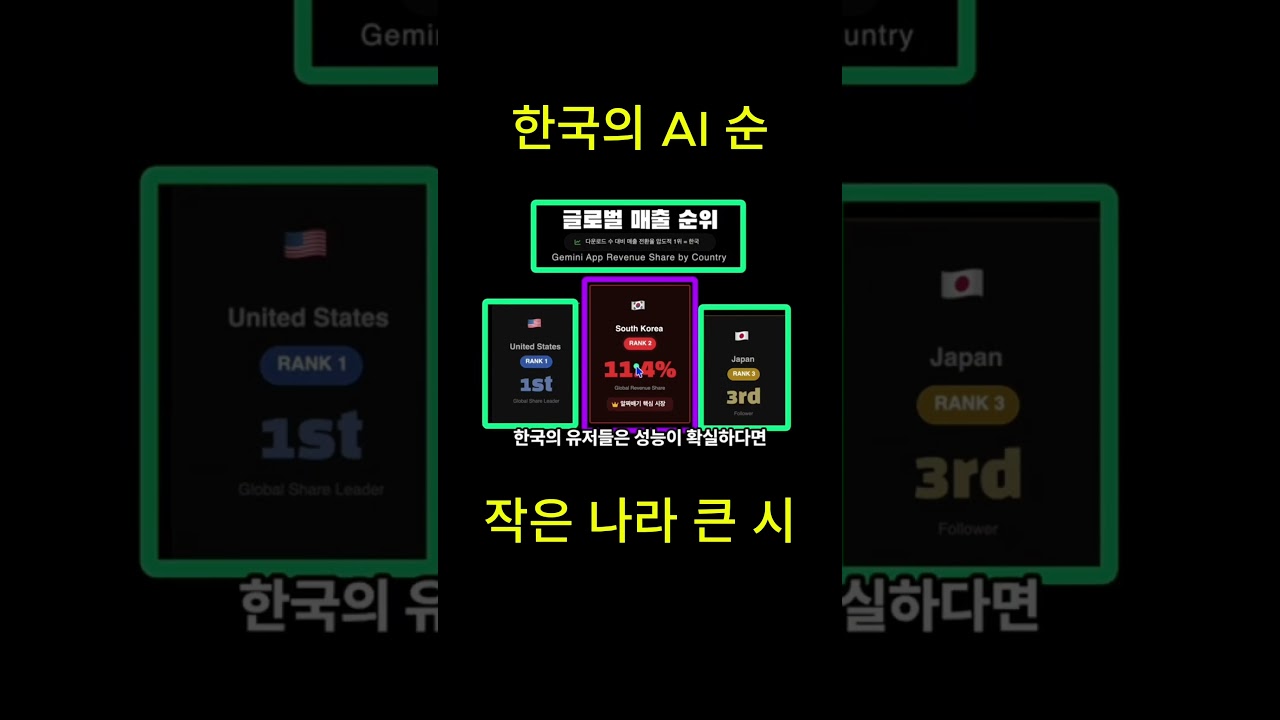
In Gemini's global iOS revenue, the US is number one, and surprisingly, South Korea is number two with 11.4%, surpassing Japan. This means Korea is the so-called 'blue-chip' market with the highest revenue-to-download ratio. It's proof for Google that Korean users are ready to open their wallets if the performance is guaranteed.
Furthermore, user behavior patterns are also changing.
In the past, many people used only GPT, but now 40.8% of GPT users also use Gemini simultaneously. As usability has greatly improved not just on the app but also on the web, cross-platform usage across PC and mobile has nearly doubled. This is strong evidence that Google Gemini is not just a simple chatbot, but is deeply integrating into our daily lives and work.
Conclusion: OpenAI's Code Red has become a reality.
Remember the rumor that Sam Altman declared a Code Red within the company? Looking at this data, it wasn't a rumor; it was a fact.
With the overwhelming cost-effectiveness and performance of Gemini 3 Flash as its weapon, Google is perfectly integrating AI into the Google Search and Android ecosystems.
The time has come when GPT can no longer survive on the title of 'pioneer' alone. Google has caught up in performance, the price competitiveness is beyond comparison, and Google is dominant in ecosystem control. On top of that, emerging powerhouses like Claude and Grok are fiercely penetrating the gaps left by GPT.
People no longer bother with complex prompts. They just open Google, ask a question, and upload a photo. That seamless experience is encroaching on the Korean market, and the world.
Are you still using GPT out of habit? Or are you feeling the terrifying growth of Google?
Gemini 3 Flash, and the turbulent changes in the AI market. Please leave your thoughts in the comments.
Once again, I'm conveying my conviction that Google will ultimately win. This was CallitAI. Thank you.