You Can Make Money with AI, Too!
You Can Make Money with AI, Too!
#AI #Uber #AIJobs #Future Uber Drivers' New Job: AI Trainer (Shocking) A New Way to Earn Money While Driving in the AI Era Your Job Could Also Become an AI Trainer Shocking! Uber Turns Its Drivers into AI Trainers (This is the Future of Work) "Teach AI to Drive": Uber Offers Drivers a New Way to Earn Why Drivers are Becoming More Important Than Developers in the AI Era (Uber's Real Motive)
This is shocking news. Uber has given millions of its drivers a new job: AI trainer. The era has come where they can train AI and earn money from their cars when they're not driving.
This isn't just a side hustle. It's a massive microcosm of the future of work, showing how human jobs are being redefined in the age of AI. Why did Uber start such a massive experiment? And what new opportunities does the emergence of this giant data labor market mean for us? We'll break down its true essence.
#Uber #AIJobs #FutureOfWork #DataLabeling #GigEconomy #AITrends #uber
Are you familiar with Uber?
It's the innovative startup that lets you hail a ride from anywhere in the world.
Its stock price has risen a lot recently, and its latest move is quite unusual.
Hello, this is CallitAI, your guide to surviving in the age of AI.
Everyone, this is shocking news. Uber has just turned millions of its drivers worldwide into AI trainers. Now, Uber drivers can train AI from their cars and earn money when they're not driving.
Many of you might see this news and think, "Oh, just a new side gig." But in my eyes, as an AI startup PM, this isn't just about extra income for drivers. It's a giant microcosm of the future of work, showing how human jobs are being redefined in the age of AI.
In today's video, I'll break down why Uber started this massive experiment and what the emergence of this huge data labor market means for knowledge workers like us.
- Uber's New Experiment: Digital Tasks
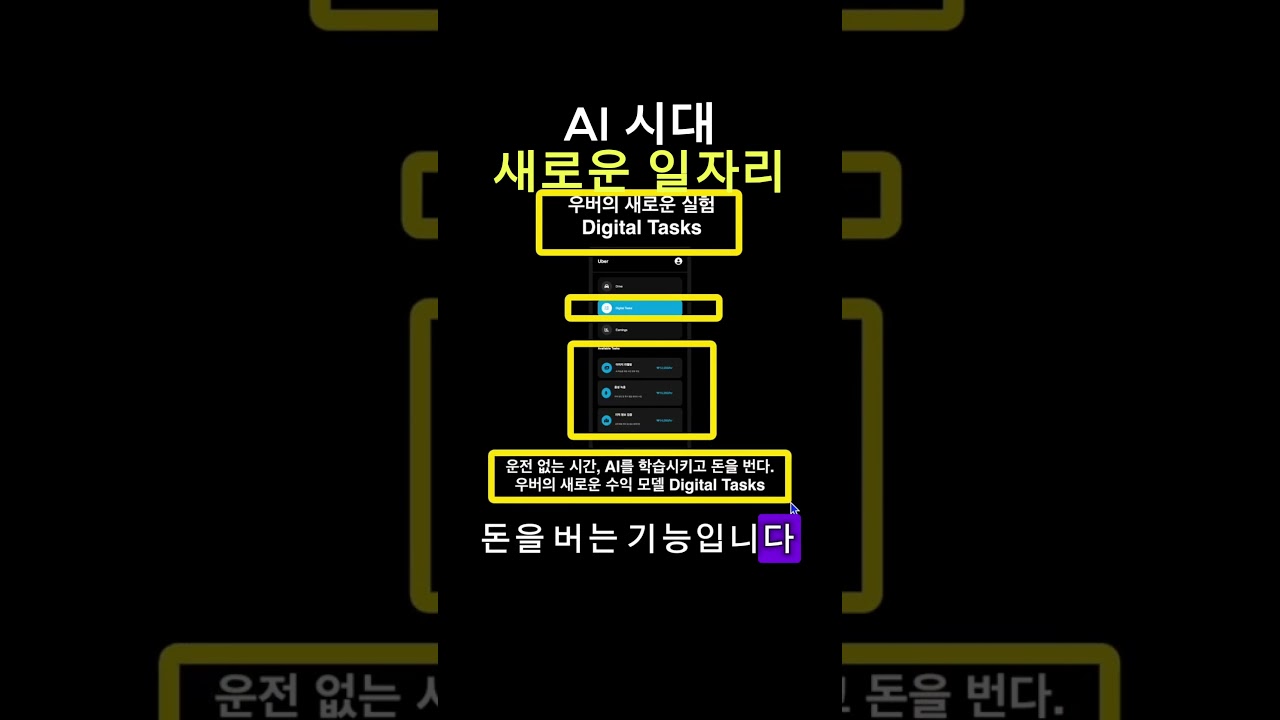
First, let's get the facts straight. Uber recently launched a pilot program called Digital Tasks. It's a feature that allows drivers to perform simple digital tasks within the app and earn money during their idle time between rides or deliveries.
What kind of tasks? It's the data labor needed to train AI.
Image labeling: Taking and uploading photos of storefronts or restaurant menus.
Voice data collection: Reading and recording specific scenario sentences in various accents.
Document digitization: Scanning receipts or invoices and converting them into text.
The tasks can be completed in minutes, and drivers are compensated per task based on difficulty. It's as if a gig work platform like Amazon's Mechanical Turk or Upwork has been integrated right into the Uber app.
- Uber's Real Motive: From a Mobility Platform to a Data Platform
So why did Uber start this? Just for the welfare of its drivers? Not a chance. There's a much larger, more calculated ambition hidden here.
From a PM's perspective, Uber is leveraging its most powerful asset—its human network spread like a web across cities worldwide—to dominate the most crucial resource of the AI era: data.
Think about it. To make AI models smarter, you need a massive amount of highly diverse, real-world data. Real-time alleyway scenes that a Google Street View car can't capture, handwritten menus at local-only restaurants, the unique accent of southern Texas. This kind of data can never be obtained by sitting in front of a computer.
Uber's plan is to solve this problem through its drivers. Millions of drivers become human sensors in their respective cities, forming a data army that collects and processes raw, real-time data for AI training.
This means Uber is no longer just a mobility platform that transports people and goods. It's a declaration of its evolution into a massive 'data platform' that produces and supplies the data that powers the AI era. In fact, Uber's AI solutions division is already creating new revenue streams by offering services like data labeling and translation to external companies.
- The Irony of the Autonomous Driving Era: Human Work Becomes Crucial Again
And here, an irony arises. Many people worried, "Won't Uber drivers all lose their jobs when autonomous cars arrive?" Uber itself has invested heavily in self-driving technology.
But in this recent announcement, Uber's Chief Product Officer said, "This program is not a replacement for drivers who might be replaced by autonomous vehicles." He emphasized that autonomous driving is still in its early stages and that millions of human drivers are still needed.
What does this mean? From a PM's perspective, it means this: for all AI, including self-driving AI, to get smarter, it paradoxically requires more human intelligence. The role of the nuanced human teacher—who tells the AI, "That's a mannequin, not a person" in an ambiguous image, or who corrects an AI's awkward pronunciation with, "In this accent, you should say it like this to sound natural"—is becoming explosively important.
Ultimately, while AI may replace simple, repetitive human labor, it is simultaneously creating a new market for data labor—for teaching, verifying, and training AI.
Conclusion: The Era of the AI Trainer, Where is Your Opportunity?
Let's wrap up. Uber's latest experiment gives us a very important hint about the future of jobs.
The people who will survive in the AI era won't just be the few AI developers who write code and build models. Rather, the majority of AI trainers—who supply data to help AI work properly, verify its output, and teach it to correct its mistakes—will emerge as the new core profession.
This doesn't just apply to drivers.
Designers: AI curators who select and refine the best design from thousands of AI-generated logo drafts to fit a brand concept.
Marketers: AI copy editors who polish AI-written ad copy into language that resonates with the target audience's emotions.
Legal experts: AI auditors who find potential poison pills or legal loopholes in contracts that AI might have missed.
The key is to use uniquely human skills—judgment, critical thinking, creative sensibility—that AI lacks, to elevate AI's output to the next level.
You are now facing a new opportunity not just to command AI, but to teach and train it.
In your field of expertise, what data could you feed an AI, what assignments could you give it, and how could you train it? Welcome to the era of the AI trainer. I hope you find your own unique opportunity amidst this huge shift. Thank you.