AI Life Hacks: A Special Lecture #Shorts
AI Life Hacks: A Special Lecture #Shorts
#AppDevelopment #Lovable #n8n #WorkAutomation #LeaveOnTime #shorts #WorkAutomation #Productivity #FakeWork #NoCode
If you're busy all day but have nothing to show for it, you're doing 'fake work'. Here's how to start doing real work with AI. 'Lovable', a tool that lets you build a web app in 1 minute just by chatting with an AI, like saying "Build me an OKR dashboard." Check out even more shocking features in the full video! Organizing customer feedback, compiling reports... Eliminate the repetitive tasks that devalue your worth with n8n automation.
Full video link: https://youtu.be/sakFzGGkoj0
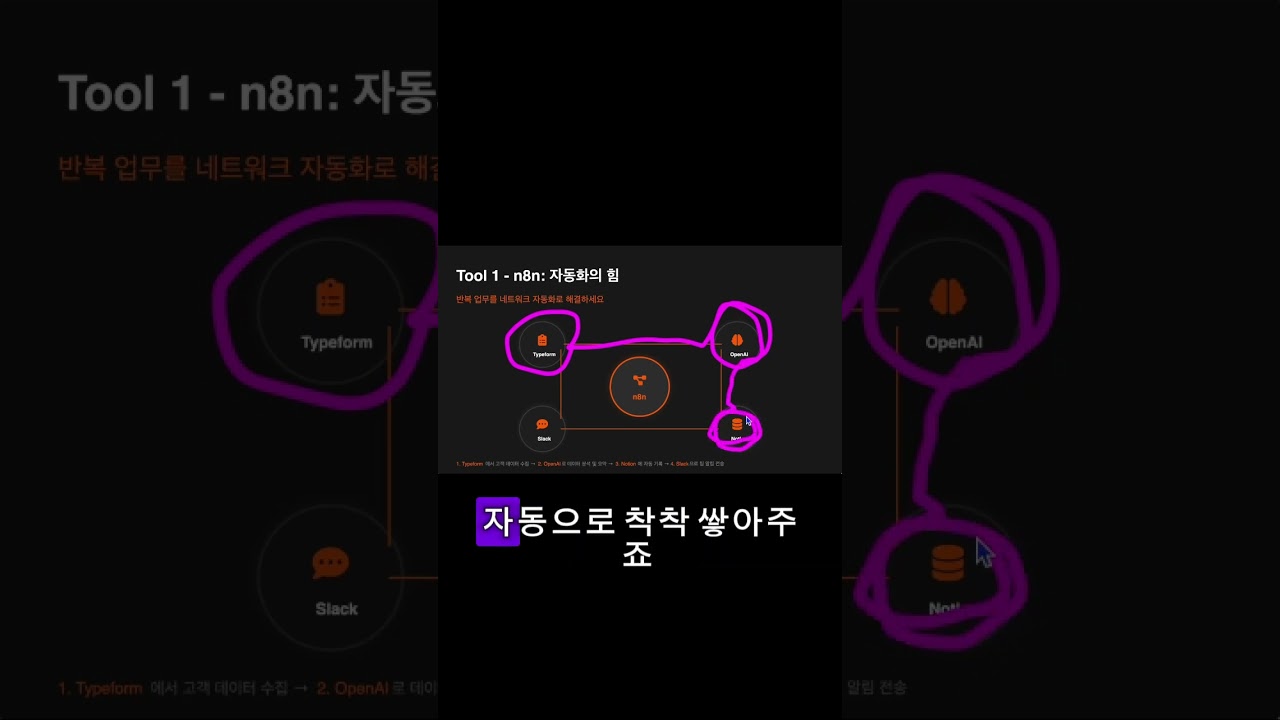
Could it be that you're just pretending to be productive? Yes, you heard that right. That moment when you've been furiously typing and jumping from one back-to-back meeting to another all day, but when you're about to leave work and ask yourself, 'What did I actually accomplish today?', you can't quite answer. We call this 'fake work'. I've spent six years as a PM with a design background at an AI startup, launching and, yes, failing hundreds of projects. Through that process, I discovered the biggest difference between successful teams and stagnant ones. It's 'leverage'. Successful teams don't grind away their members' personal time. Instead, they leverage systems and tools to produce 10, or even 100, times the results with just 1 unit of effort. The same goes for individual success now. In the age of AI, competence isn't about 'how long you work,' but 'how you create overwhelming leverage with powerful tools.' This means the era where working late was a measure of diligence is completely over. While pondering this, I came across a video by Dan Martell, a 2-million-subscriber YouTuber and successful entrepreneur whom I admire. He says something very important in the video: 'The way to get rich in the AI age isn't by working harder, but by mastering the tools that reduce your work.' It felt like I'd been hit over the head. I thought, 'This is it.' So today, I want to take Dan Martell's grand theme of 'how to get rich' and reinterpret it for the reality of us PMs, planners, designers, marketers, and solopreneurs as 'how to become an irreplaceable talent'. If you watch this video to the end, you'll get three concrete weapons that will transform you from someone wasting time on simple, repetitive tasks into a key talent who sees to the core of projects. All without developers and without a single line of code. Now, let's unveil the first weapon. The first tool is n8n. Many of you might think of 'Zapier' for work automation. While it's a great tool, the costs can ramp up quickly as your workflows get even slightly complex. n8n offers much more powerful features and is an open-source automation tool you can even start with for free. If you install it on your own server, you can use it almost without limits. Now, let's take a look at your reality. Aren't you doing these things every day? First, processing customer feedback. You receive surveys from Google Forms or Typeform, organize the results in Excel, transfer key points to Notion, and share them with the relevant department on Slack. You're probably spending at least 30 minutes a day on this process. Second, weekly progress reports. Are you spending all your crucial morning hours every Monday scraping your tasks from Jira and Asana just to decorate a PowerPoint or Notion page for your report? Third, new customer onboarding. When a customer pays for your service, you send a welcome email, register their information in your internal CRM, and send a Slack notification to the person in charge. If you're still doing all of this manually, you're letting your time be stolen. These tasks are the 'fake work' that devalues you. They're simple labor that requires no creativity or expertise. Now, look at the screen. This is n8n's workflow builder. It doesn't look like coding; it's more like assembling Lego blocks. I'll show you a workflow I actually use. See the 'Typeform' node here? When new feedback is submitted, this workflow starts. Following the arrow, you see it connects to an 'OpenAI' node, which summarizes the incoming feedback text into just three lines and even performs a sentiment analysis to see if it's positive or negative. Then, it sends the results to a 'Notion' node, automatically stacking the data neatly in a database. Simultaneously, a 'Slack' node sends a notification to the designated channel: 'New customer feedback has been registered!' along with the AI's summary. Building this workflow once takes just 30 minutes. But with this 30-minute investment, you'll save an hour every day and evolve from someone who merely copies and pastes feedback into someone who 'derives insights from AI-analyzed data.' Which person will be recognized for higher value? The answer is clear. The second tool is Lovable. Let's be honest, you probably have at least 10 ideas for a service that you think, 'Wow, this would be a huge hit,' just sitting in your head, right? But why can't you execute them? Because you have to write a complex spec to explain it to the dev team, ask a designer to draw up wireframes... The process is so long and complicated that the steam runs out before the idea becomes a reality. Lovable completely shatters this process. It's a service where you literally build websites and apps by 'chatting' with an AI. Seeing is believing. I'll show you the process of me giving instructions to the AI directly. Okay, I'm now going to build 'a simple dashboard to manage our team's OKRs.' No coding, no Figma, nothing. I'm just going to type it here in Lovable's chat window. I'll type this: "Create the main screen. Set the title to 'CallitAI Q3 Goals' and show three objectives in a card format." Now, look at the screen. The basic structure is created in an instant. Amazing, right? Let's get a bit more detailed. I'll type again: "Allow three key results to be added to each card, and next to each key result, add a progress bar that can be adjusted from 0% to 100%." Did you see that? The card UI on the screen updated instantly, and a functional progress bar appeared. As a PM with a design background, this was truly shocking. In the past, creating just this one screen would have taken at least half a day—planning meetings, drawing in Figma, handing it off to a developer... But now, it took less than a minute. And it doesn't end here. When I type, "Add a dark mode toggle button in the top-right corner," a dark mode toggle appears on the screen, and clicking it actually turns the screen dark. Are you getting the picture? This isn't just about creating mockups. It's the experience of assembling a working web app by conversing with an AI. Now, you no longer need to create a 50-page PowerPoint to explain your ideas. Just open Lovable and turn your ideas into reality with your words. Whether it's an internal tool for your team or an MVP for customer validation, you can build anything.
The final, third tool is Atlas. This is the tool Dan Martell explained first and for the longest time. It's commonly used for capturing B2B sales leads, but I approach it from the perspective of 'automating initial customer interviews.' Imagine you've built an amazing service as a side project and gathered 100 beta sign-ups. Listening to the voices of these 100 people is the key to success. But when are you going to email all of them, call them, and schedule interviews? For a solopreneur, it's next to impossible. Atlas is a service that lets you hire an AI voice agent, or an 'AI voice assistant.' While you're sleeping, this AI assistant calls all 100 of your potential customers. It asks the questions we've pre-designed, receives their answers, transcribes them into text, and even creates a report. For example, you could enter a script like this into Atlas. The AI would make a call like this: 'Hello, [Name]. This is the AI agent from CallitAI. Thank you for signing up for our beta service. May I ask you a few quick questions?' If the person says 'yes,' it continues: 'Thank you. Could you tell me what problem you were hoping to solve by signing up for our service?' 'What feature are you most excited about in our service?' What if the vivid answers from 100 people, collected this way, were perfectly organized on your Notion page the next morning? Based on this, you could prioritize product development and refine your marketing messages. By automating the process of listening to your customers, you can understand market needs and improve your product 10 times faster than your competitors. Today, we've taken a deep dive into three tools: n8n for automating repetitive tasks, Lovable for turning ideas into reality, and Atlas for automating customer validation. Do you see what these three tools have in common? They transform you from a 'bricklayer' into the 'architect who designs the building.' They allow you to focus your limited resources—your time and effort—on what's most valuable: the essential work of 'setting strategy, solving creative problems, and deeply connecting with customers.' This is the power of 'the one who masters the tools' that Dan Martell talked about, and it's the key secret to not just surviving, but growing exponentially in the age of AI. Take a look at your to-do list today. And ask yourself this question: 'Which of these tasks can I delegate to AI?' The tools introduced today will be a powerful compass on your journey to find the answer to that question.