Who's Real and Who's a Fraud? The 5-Level Framework for Spotting Fake AI Startups #aitrends #bitcoin #entrepreneur
Who's Real and Who's a Fraud? The 5-Level Framework for Spotting Fake AI Startups #aitrends #bitcoin #entrepreneur
Right now, all eyes are on the 'Davos Forum'. The Davos Forum used to be a place for respectable discussions about things like climate change and poverty, right? But this year, the atmosphere is completely different. It's turned into a giant tech octagon.
Big tech CEOs like Elon Musk, Jensen Huang, and Satya Nadella all gathered in one place, and instead of exchanging pleasantries, they engaged in a verbal brawl that was just short of drawing knives. On the surface, they talked about the rosy future of AI, but underneath, there was a palpable fear of protecting their own turf and a potential bubble burst.
In particular, the moment when Anthropic's CEO, Dario Amodei, openly took a shot at Nvidia was a real highlight. After all, Anthropic is a key customer that buys a massive number of GPUs from Nvidia, right? Yet, Amodei had this to say about Nvidia selling chips to China:
"An AI data center is like a country full of geniuses. But exporting chips is like handing over that entire country of geniuses to China and giving them control."
He lambasted. He wasn't just talking about technology; he was delving into international politics and trade issues.
And what about Microsoft's Satya Nadella? He revealed his blatant true intentions by calling data centers 'token factories'. "Folks, if more people don't use AI, this will all become a bubble, and we'll all go down together," he said, in a statement that sounded almost like he was begging for users. He sugarcoated it by saying we should be wary of AI being concentrated in certain wealthy nations, but in the end, it reeked of a desperate plea: "Please use our services more."
Nvidia's Jensen Huang was no different. "We are not investing enough yet. We need to pour in more money to keep this industry running," he clamored. On the surface, he talks about creating jobs, but underneath lies the anxiety that they need to make the pie bigger before the bubble bursts.
What does all this mean? It's proof that the current AI market is fiercely competitive and, at the same time, built on a foundation of instability, ready to burst at any moment.
But this cutthroat atmosphere isn't just limited to Davos. According to a domestic article I referenced, the Korean business world is also on high alert. I analyzed the keywords from the New Year's addresses of Korea's top 10 conglomerates, and what do you think was the most frequent word? Yes, it was AI. A keyword that was outside the top 10 last year shot up to first place this year, mentioned a total of 44 times. SK declared it would create a whole new business model with AI, and Samsung Electronics is also championing AX (AI Transformation) innovation.
Now, this is where we need to be level-headed. The brawl at Davos, the desperate declarations from Korean conglomerates... Behind all these phenomena lies one fundamental question.
"Who is actually trying to make real money?"
"And who can actually make real money?"
AI startups are now springing up left and right. Legendary developers are starting companies, and trillions of won in investment funds are pouring in. But when you actually look under the hood, it's often impossible to tell if they're trying to build a real business or just having fun with research using investor money.
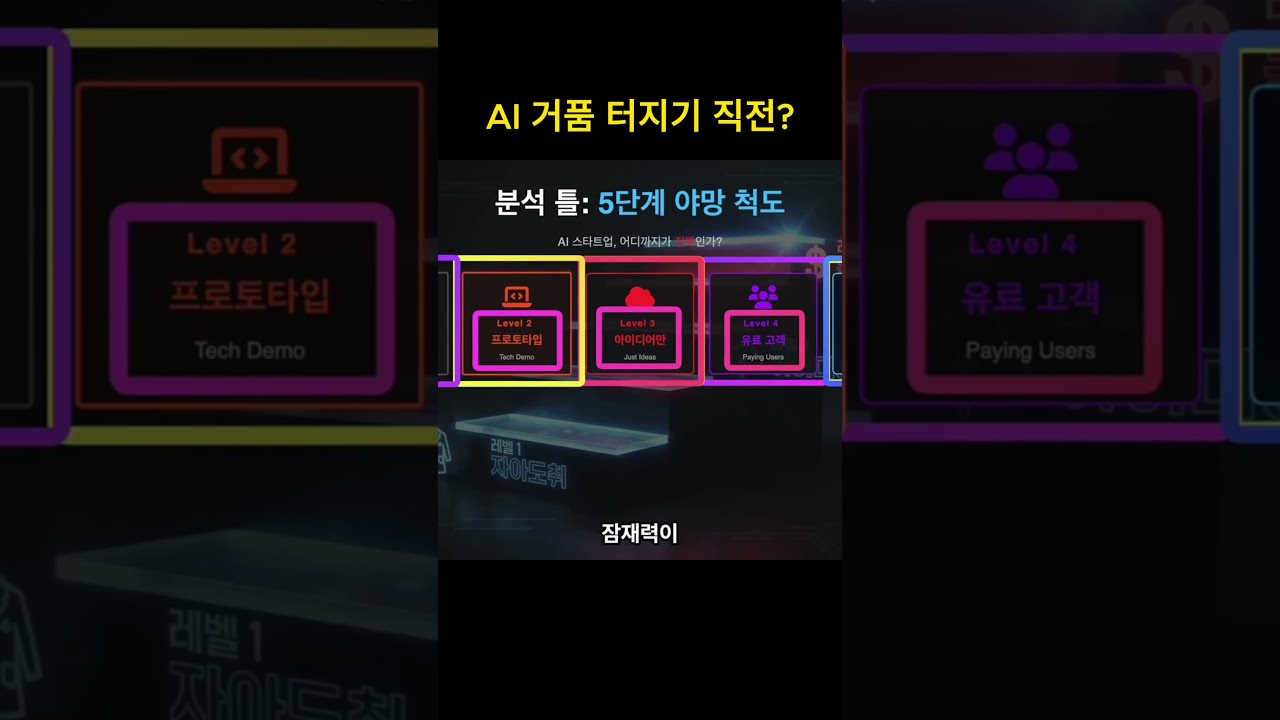
So today, I've brought a very interesting analytical framework. It's the 5-Level AI Ambition Scale, which measures the ambition of current AI companies. Using this scale, proposed by TechCrunch, I'll help you distinguish between the real players and the fake players in the market today. Investors and those preparing for a career in the AI industry, you need to perk up your ears and listen closely from this point on.
First, let me explain what these 5 levels are. This isn't about how much money they're actually making, but is categorized based on how strong their will to make money is.
Level 5 is the "We're already raking in billions every day, thank you" stage. Giants like OpenAI, Google, and Anthropic belong here. They already dominate the market and have a solid revenue model in place.
Level 4 is the "We have a very specific, step-by-step plan to become the richest on Earth" stage. They aren't raking in as much cash as Level 5 yet, but they have a clear business roadmap and are sprinting like mad.
Level 3 is the "Our idea is really good, but the money will come eventually, right?" stage. The technology is good, but the concrete picture of how to monetize it is still blurry, and while they have many product ideas, the launch dates are TBD.
Level 2 is the "Well, we have the rough outline of a plan" stage. They are still in their infancy or are more focused on the technology itself rather than the business.
Finally, Level 1 is the "True wealth is loving oneself" stage. Absurd, right? These are the pure academics whose goal is research itself, rather than making money. Investors also tell them, "Okay, you just focus on research, we'll provide the money." But what's scary about them is their potential to jump to Level 5 at any moment.
Alright, now let's use this scale to brutally dissect four of the hottest AI labs right now. These are the ones causing the biggest buzz in Silicon Valley lately.
First up is Humans&. It's received a lot of attention recently. Their vision is to create communication and collaboration tools that go beyond simple calculations, using next-gen AI models. They say they'll build a post-software to replace Slack or Google Docs.
The problem, however, is that despite the media praise, it's completely unclear how they plan to make money. They say they'll build a product, but they're cagey about what exactly they'll sell. They just say, "We're going to do something great," but the business model is nowhere to be seen. It's a classic Level 3 company. The technology is interesting, but from an investor's perspective, it's a head-scratcher.
Second is Thinking Machines Lab. Hopes were high for this one because it was founded by Mira Murati, the former CTO of ChatGPT. Who is Mira Murati? She was a core figure at OpenAI. That's why, until early 2026, everyone saw it as a Level 4 company—one with a solid roadmap. After all, it received a staggering 2 trillion won (over $2 billion) in seed funding.
But something shocking happened in the last two weeks. Co-founder and CTO Barrett Zoph left, and five key personnel followed him out the door. Half of the executive team was gone within a year of its founding. The departing employees said they were "concerned about the company's direction." What does this mean? It means that while it pretended to be Level 4 on the outside, a look inside revealed nothing more than a flimsy plan at a Level 2 or 3. They left as if to say, "We thought we were joining a world-class lab, but it turns out there's no plan?" This is a very dangerous signal to the market.
Third, the protagonist of a surprising twist, World Labs. This company was founded by the godmother of AI research, Professor Fei-Fei Li. Since it was founded by an academic giant, everyone thought, "Oh, that's probably a research lab run by professors. It'll be a Level 2 at best." Even when it received $230 million in funding, people were skeptical.
But what a surprise! In just one year, it showed a completely different side. It didn't stop at just research; it commercialized its World-Generating Model, which creates 3D spaces, and released it as an actual product. Real demand is exploding from the gaming and special effects industries. They've accomplished something that other major labs haven't been able to do yet. We thought they were scholars, but they turned out to be real businesspeople. World Labs is now a solid Level 4, and perhaps the strongest candidate to enter Level 5 soon.
Finally, we have Safe Superintelligence (SSI). This is the company founded by Ilya Sutskever, OpenAI's former chief scientist. Just look at the name: Safe Superintelligence. It doesn't smell of money at all, does it? They even rejected an acquisition offer from Meta and have stated they will focus solely on superintelligence research with no product launch plans. And yet, they pulled in nearly 4 trillion won (about $3 billion) in funding. This is a quintessential Level 1.
But don't let your guard down. In a recent interview, Ilya Sutskever hinted, "If the research takes longer than expected, or if a very powerful AI can make an impact on the world, we might change direction." The AI world moves incredibly fast. This means that depending on their research outcomes, this pure research institute could transform into a commercial monster overnight.
So, why have I told you this long story?
The AI market right now is pure chaos. At the Davos Forum, big tech CEOs are grabbing each other by the collar, shouting, "Give us the money before the bubble bursts!" Korean conglomerates are crying 'AI' for their survival, and startups are walking a dangerous tightrope between ambition and reality.
If you're an investor, or someone who wants to work in this industry, you need to be able to see these levels. Don't be fooled by the flashy investment figures or the founder's brand name.
You must distinguish who has a real business model, who is all flash and no substance, and who is sharpening their knives for the future.
The bubble will burst someday. What Satya Nadella said at Davos—"Folks, if you don't use more, we're toast"—wasn't just an empty threat. When the current hype cools down, only the Level 4 and 5 companies that are ready to make real money will survive, and the rest will disappear into history.