Remember Just One Thing in the AI Era
Remember Just One Thing in the AI Era
#AI #JensenHuang #NVIDIA #Success #LifeAdvice #Shorts
NVIDIA CEO's survival guide for the AI era (just one thing is enough) Jensen Huang: AI will make you superhuman (interview summary) The emperor of the AI empire, Jensen Huang, predicts the future (and what you need to do) NVIDIA CEO's survival tip for the AI era (just one thing) Remember just one thing in the AI era Jensen Huang: AI will make you superhuman
Whether you know it or not, the decisions of NVIDIA CEO Jensen Huang are shaping your future. AI, robotics, autonomous vehicles... at the heart of future technology lies the GPU he created. In a recent interview, he revealed everything about the past, present, and future of the AI era. As a 6th-year PM at an AI startup, I'll completely break down 3 key insights from his extensive interview that will directly impact your career, along with the single piece of advice he offers to the younger generation.
The emperor of the AI empire, NVIDIA CEO Jensen Huang, said: How to survive in the AI era? It's nothing grand. "Ask yourself how you can use AI better in your job." AI is not a threat, but the most powerful tool to make you superhuman.
Everyone, you know NVIDIA, right? I'm actually quite fond of investing myself. I personally own some NVIDIA stock, and honestly, I can't believe it every time I check my account in the morning. Look at this graph. The speed is just insane. It hit a $2 trillion market cap in March 2024, reached $3 trillion just three months later in June, and is now racing towards $4 trillion like crazy. I vividly remember being surprised by an article not too long ago that NVIDIA's market cap had become similar to the entire market cap of Korea's KOSPI. Now, it has grown to be nearly twice the size of Korea's entire stock market—KOSPI, KOSDAQ, and KONEX combined. What on earth is happening? In today's video, I'll explain everything about how this monster called NVIDIA was born, why it's growing so insanely, and what opportunities we should seize in this massive wave, switching between the perspectives of an AI startup PM and an investor. First, NVIDIA, the company that became a god First, you need to feel the sheer scale of NVIDIA's current status. A $4 trillion market cap. That's about 5,500 trillion Korean won. It's more than double South Korea's annual GDP and enough to buy 15 Samsung Electronics. It's the first company in global corporate history to surpass $4 trillion. Not even Apple, Microsoft, or Google has achieved this. Why? There's only one reason: AI. To train AI and run services like ChatGPT, high-performance AI semiconductors are essential. And the heart of those semiconductors is the GPU, or Graphics Processing Unit, made by NVIDIA. NVIDIA has a virtual monopoly, controlling over 80% of this market. From a PM's perspective, this is an insane moat. It's a structure where every company wanting to enter the AI era must pay a toll to the single fortress of NVIDIA. The bigger the AI market gets, the more money NVIDIA is bound to make. Second, the monster born from failure: Jensen Huang's leadership So how did NVIDIA build this formidable monopoly empire? At its center is the Taiwanese-American immigrant CEO, Jensen Huang. In 1993, he founded NVIDIA with $40,000, but his first and second products failed miserably one after another, pushing the company to the brink of bankruptcy. From then on, NVIDIA's unofficial motto became, 'Our company is 30 days from going out of business.' This desperation was the driving force that brought him to where he is today. He is still famous for his 'playing coach' leadership, staying up all night to edit presentation slides himself. A perfectionist who is hands-on in the field, taking care of everything. This is the first secret to how NVIDIA has always been able to stay one step ahead of the market. Third, the great pivot: from a graphics company to an AI company The second secret is a bold pivot. In the early 2000s, NVIDIA was the number one player in the gaming graphics card market. It was a situation where anyone would have been satisfied and complacent. Then, Stanford researchers published a small paper showing that using GPUs could speed up AI training by tens of times. Most people ignored this small development. But Jensen Huang was different. He saw the future in this small paper. One evening, he sent an email to all employees: 'We are no longer a graphics company. From now on, we are an AI company.' And he began to invest heavily in a software platform called CUDA. CUDA is like an operating system that allows AI developers to use NVIDIA's GPUs more easily and powerfully. And CUDA only works on NVIDIA GPUs. This was a god-tier move. It completely locked the world's AI developers into NVIDIA's ecosystem. Conclusion: So, when will this bubble burst? Of course, some are raising concerns about a bubble. They say the rise has been too steep. But from a PM's perspective, this might not be a simple bubble. NVIDIA has already made deep inroads into the next era's growth engines, like humanoid robots and autonomous vehicles. The AI wave has just begun, and the surfboards needed to ride that wave are exclusively supplied by NVIDIA. One analyst predicts NVIDIA's market cap will surpass $5 trillion within 18 months. As a personal investor and a PM in the heart of the AI industry, I have yet to find a reason not to ride this massive wave.
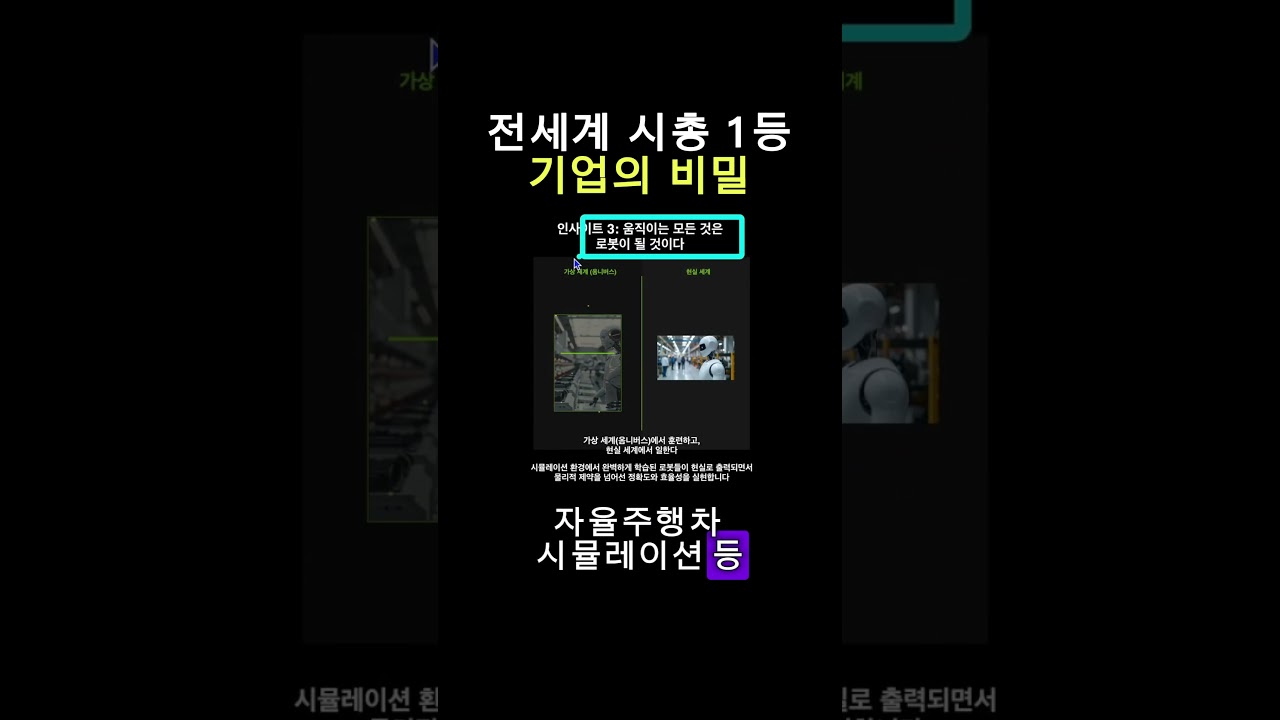
This is Part 2. From now on, I'll cover it from my channel's original perspective! Everyone, this person you're looking at is Jensen Huang, the CEO of NVIDIA. Whether you know it or not, his decisions are shaping your future right now. AI, robotics, autonomous vehicles, new drug development... at the heart of almost every technology we call the future, the semiconductor he created—the GPU—is beating. In a recent interview, he revealed everything about where the AI era began, where it is now, and where it's headed. In today's video, I'll completely break down 3 key insights from his extensive interview that will directly impact your career and business, along with the single piece of advice he offers to the younger generation. First, all innovation starts from a 'useless' place. How did NVIDIA build its current empire? Surprisingly, it all started with video games. In the early 1990s, Jensen Huang focused on the simple, repetitive calculations that made up 99% of computer programs—in other words, parallel processing. He determined that the place where this technology was most needed was the video game market, which required rendering 3D graphics. At the time, it was a 'useless' market that no one was paying attention to. But he was convinced that video games would become the largest entertainment market in human history, and he created the best parallel processing unit—the GPU—for that market. His prediction was spot on. The video game market grew explosively, and NVIDIA became its ruler. And in 2012, a groundbreaking event occurred when an AI model called AlexNet used that very gaming GPU to make history in AI. From a PM's perspective, this gives us a huge lesson. A massive, future-changing opportunity can be hidden in a seemingly 'useless' technology or market that doesn't seem profitable right now. Innovation always starts on the periphery. Second, technology makes time travel possible. Jensen Huang calls the GPU a time machine. What does this mean? A quantum chemistry scientist reportedly told him, 'Jensen, thanks to your technology, I can now complete my life's work within my lifetime. This is time travel.' Simulations that used to take years on a supercomputer have now been shortened to days or even hours with GPUs. We can now preview and simulate the future at speeds unimaginable in the past, in fields like new drug development, climate change prediction, and autonomous vehicle simulations. This isn't just about work getting done faster. It means that as the cost and time of failure have dramatically decreased, an era has opened up for more audacious and creative challenges. Productivity improvement in the AI era is directly linked to the ability to save time. Third, everything will become a robot. Jensen Huang asserts: 'Everything that moves will one day be robotic. And that day is coming soon.' The robots he talks about are not limited to factory machine arms or autonomous vehicles. It ranges from lawnmowers to personal assistants like R2D2 that grow with us throughout our lives. So how do these robots get smart? In virtual worlds called Omniverse and Cosmos. In the past, robots had to be trained in the real world. It took a long time, was dangerous, and cost a lot.
Conclusion: Jensen Huang's one piece of advice So, in this era of immense change, what should we prepare for? Jensen Huang's advice is surprisingly simple: 'Ask yourself how you can use AI better in your job.'